Ambient Machine
A Raspberry Pi Pico 2 turns a monophonic keyboard into an ambient instrument with harmonies, granular effects, loops, drums and sequences.
- Kind
- Synth
- Status
- Built
- Year
- 2026
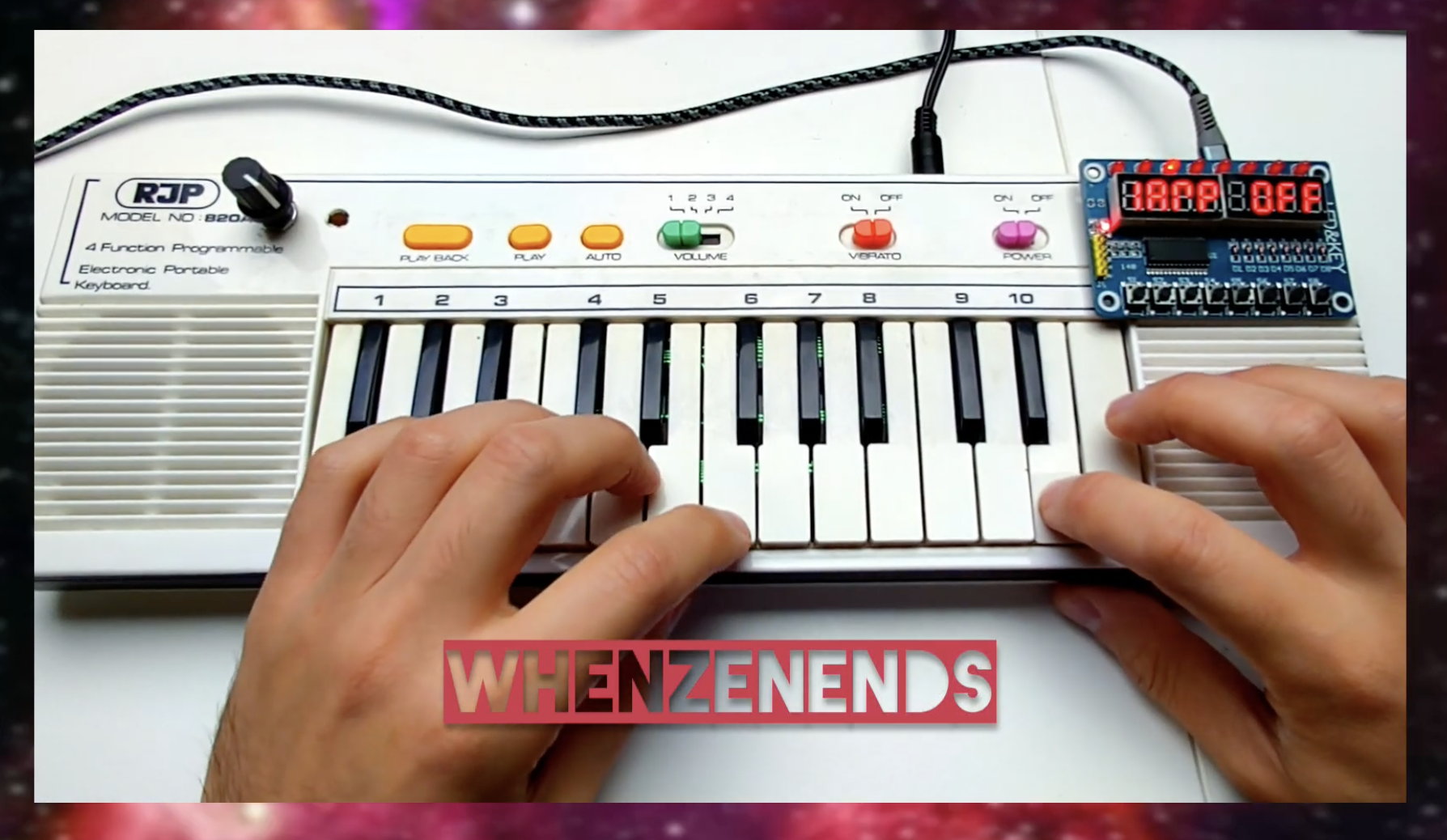
The Ambient Machine is a small instrument built around a Raspberry Pi Pico 2. Play a note on a monophonic keyboard and shape it into synth layers, harmonies, delays, granular textures, loops, drums and sequences. Eight buttons, a rotary encoder and an eight-digit display keep the controls direct, without menus to dig through.
It grew out of an earlier keyboard project and its audio input and output experiments. I wanted to turn the keyboard’s one-note-at-a-time limit into a starting point for ambient music: hold a note, add harmony, layer loops and build longer sequences on the same compact hardware.
Inside the box
- Raspberry Pi Pico 2 running the sound engine at 32 kHz
- TM1638 board with eight buttons, LEDs and an eight-digit display
- Rotary encoder for changing values across the pages
- PCM5102 I2S DAC for stereo output
- Monophonic keyboard input, with pitch detection for the synth and sequencer
The firmware grew to about 2,300 lines across ten files. It was built in short cycles of designing, coding and testing on the board, with computer simulation used between hardware builds.
Eight pages
- Sound: shape the keyboard, play synth voices, and add envelope, vibrato or arpeggio
- Harmony: add in-key voices, from thirds and fifths to triads, octaves and clusters
- Space: explore delays, granular effects, reverb and freeze
- Loops: layer three loops with overdub, speed, scatter and fade
- Drums: program kick, snare, hat, bell and tick patterns
- Sequence: record played notes into a sequence and choose how it runs
- Load: save and reload up to eight slots
- Settings: adjust levels, tempo and input, use the tuner, or clear the machine
Each page follows the same gestures: hold the encoder button and press a numbered button to change pages; tap to select; turn the encoder to set a value; tap again to trigger an action.
Video
Watch the Ambient Machine in action
The current version works on the board. It follows one clean note at a time, with around 40–100 ms of response time, and loops are cleared when power is removed.
I fixed the hissing at the audio jack output with a low-pass filter made from a 10 kΩ resistor and a 10 nF capacitor.